I recently reviewed Obsidian by Suzie Wilde, which is pitched as ‘A gripping Viking tale of one woman’s courage, fighting old and new gods amid the savage beauty of Ice Island’. I love historical fantasy novels and especially books with a strong female protagonist, and was intrigued enough ask Suzie some questions. Here’s what she said.
GG: Suzie, you write very believable characters; they are all flawed, and all have some redeeming aspect. Your protagonist Bera is complex; powerful yet insecure, tender yet sometimes spiteful. What was your inspiration for her?
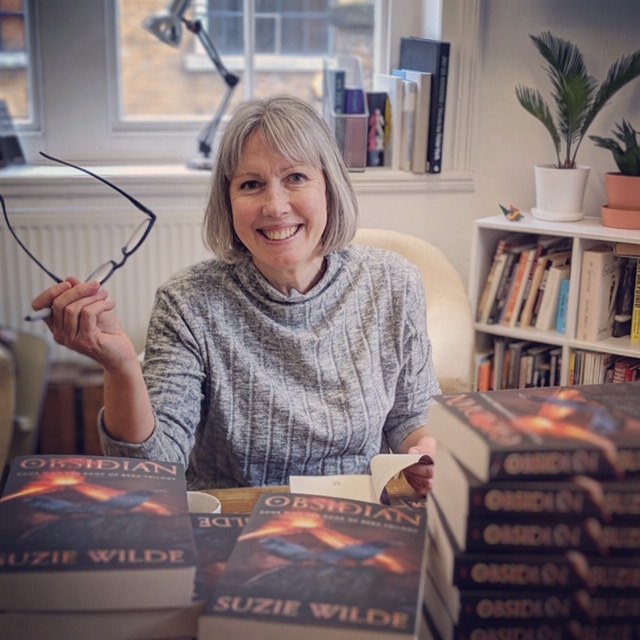
SW: All characters are a mix of an author’s experience, personality and imagination. You begin with a short acquaintance with the first sketchy drafts, then get to know them better as the plot develops and then in later drafts they make decisions and do stuff. I love the ‘Oh there you are’ moment when, as Kate Mosse puts it, the characters pass from behind to walk in front of you. They can be guided of course but can clearly be seen, like real people, and that’s often when the author gets out of the way so the reader can see them clearly too.
GG: You write beautifully about the landscape of Iceland, or Ice Island as it becomes in Obsidian, and the climactic scenes during a volcanic eruption are masterful. Have you ever seen an eruption, up close and personal?
SW: That’s why we have YouTube! I was a maritime researcher and read many accounts written by people who have experienced these events. There are a few groups I follow on Twitter and Instagram, who post stunning images (#volcano or #iceland will pull up loads).
GG: Bera’s world seems very Viking at first, yet it rapidly diverges from Norse culture, particularly in their belief system; Bera is a seeress rather like a Nordic Völva, yet there is little mention of the Norse pantheon of gods. The dead don’t go to Hel or Niflheim but might lurk as ‘drorghers’ to plague the living. Did you set out to create a whole new world view, or did it evolve as you wrote?
SW: I wanted readers to feel they had fallen through a trapdoor into a world only slightly strange. It’s a carefully researched Norse world, as far as it goes, except I’m not keen on having gods involved. They don’t infest the everyday now, so perhaps they didn’t then. The book is written in English, dialogue included, so I didn’t want sudden Old Norse words. Instead I’ve based these fantasy elements on what we know of their beliefs, so drorgher comes from draugr, the walking dead. By a similar process, as you note, Iceland becomes Ice Island. It’s to suggest to readers a slight ‘otherness’.
Anyone who likes Philip Pullman, J.R.R. Tolkien and C.S. Lewis might enjoy spotting a similar ‘Norseness’ with their daemons, the Valar and Eldila, respectively. Tolkien was famously a professor of Anglo Saxon at Oxford. I studied it at UCL, where I fell in love with Beowulf, as so many others have over the years. I envy W.H. Auden, who wrote, years later, to his former professor, ‘I don’t think that I have ever told you what an unforgettable experience it was for me as an undergraduate, hearing you recite Beowulf. The voice was the voice of Gandalf.’
GG: You write very evocatively about boatbuilding and the sea. Is that drawn from personal experience?
SW: I grew up beside the sea and my father built boats as a hobby. I love the smell of marine ply. I used to play among the rotting hulks while he worked on converting an old lifeboat. Named the Freya, she went out with the ice after only one summer afloat, when I was nine. Loss is a powerful theme in the trilogy.
GG: Sea Paths and Obsidian are stand-alone books, but they are the first two parts of a trilogy. That’s a huge sweep of a story and an impressive undertaking. Did you have the whole series in your mind when you started?
SE: Bera stormed into my life while I was trying to write a crime thriller. Book 1 was intended to be the whole story – but once I had finished it Bera wouldn’t let go. I was even dreaming about her, and other characters too, even the dog! Luckily, enough readers kept asking me what happens next that I had an excuse to work that out. Each book explores what ‘Home’ means and where do you belong if you always keep moving? I don’t like narrative weighed down with backstory: Sea Paths starts on Day One and always moves forward – why Lee Child loved it – so if you read Obsidian it’s the same, except readers of the first will know more backstory. If you’re someone who wants more detail about a character’s past, then you might like to read them in order. At their most basic, Sea Paths is a revenge thriller and Obsidian a quest, though both have a thriller structure.
GG: Any sneak previews of Book 3?
SW: My editor is the brilliant Liz Garner, whose father Alan has been a hero of mine for years. They both hug a story while it’s forming, as if its magic will vanish if spoken. I’m staying silent about Book 3 until it’s done, except to say that the themes of Home and Belonging are resolved, and that this will be the last in the series. It’s quite a challenge to satisfyingly have new story and characters each time, but not leave anything unresolved across the whole series.
GG: I share your respect for Alan Garner. I learned a lot from ‘The Voice That Thunders’. Suzie, thanks so much for sharing your thoughts with us. I’m looking forward to the next, and last instalment of Bera’s adventures.
Obsidian is published by Unbound. Click here for my review on Amazon.
As anyone who has read Saxon’s Bane knows, I like to write stories where worlds collide. Not, I hasten to add, in the astronomical sense; I don’t write Science Fiction, but I do like the past to echo in the present. Even better, to play on it in a way that has the reader wondering if there is more in today’s world than can be explained by science.
Weaving the past into the present
In a previous post I described how the initial idea for Draca came at anchor in a friend’s boat, watching the ebbing tide reveal the bones of dead ships. What else did the silt’s ancient layers conceal? After all, Guthrum’s Viking army wreaked bloody havoc in that very harbour during their war with Alfred. There’s a contemporary, 9th Century poem by Torbjøn Hornklov which evokes the moment when the dragon ships surged out of the mist:
Ships came from east-way,
All eager for battle,
With grim gaping heads
And rich carved prows.
They carried a host of warriors,
With white shields
And spears from the Westlands
And Celt-wrought swords.
The berserks were roaring
(For this was their battle),
The wolf-coated warriors howling,
And the irons clattering.
But how might such a moment impact the present? Weaving history into a contemporary novel is tricky. In Saxon’s Bane I set whole chapters in the Saxon era. In Draca I took a more subtle approach, revealing the past through the contents of an old man’s bookshelf; his diaries, his obsessive research into his own Danish heritage, and his copies of the ancient sagas. If the tidal scour revealed a Viking artefact, he’d probably keep it. His diaries could reveal his mental disintegration, until he dies raving that he ‘tried to give it back’.
The joys of research
Researching a book can be wonderfully diverting. It sucks time as you wade through bogs of facts. Whole days sink without trace. That old man dies in the first chapter and it’s his legacy that triggers events. Still, just populating his bookshelf mired me very happily in perhaps a month of reading ancient history. I could use almost none of it. All for a book set in the present day.
There are a few exceptions. A dictionary of Old Norse taught me obscure words that became chapter titles; (Chapter 1: Arfræningr, one stripped of his inheritance). Snorri Sturluson’s 13th Century Heimskringla taught me the lilt and vocabulary of Old Norse, even in translation. It taught me enough to ‘book-end’ chapters with short extracts from a Viking saga.
So readers of Draca will find slices of history framing a modern tale; slices that tighten the tension as the ancient and brutal past starts to resonate ever more loudly in the present. Next year, after publication, you’ll be able to tell me if it worked. For now, here’s how that back story begins.
Enjoy!
From the saga of King Guthrum, c.875AD
That winter King Guthrum laid down a mighty dragonhead ship for his son Jarl Harald, whom he loved and honoured most of all. Of oak did he build it, cut finely that it might bend with the sea, with benches of pine for twenty oars on the one hand and twenty on the other. The fittings were splendid, as befits a great jarl, and a richly carved strake rose to a wondrous dragonhead at the prow. As was the custom, this could be taken down, like the helm of a warrior, lest it offend the landvættir, the land spirits.
Then Guthrum and Harald made sacrifice in this wise: Harald took a stallion that he loved, and calmed the beast, covering its eyes that it might not see whence the blow would come. Then they took their axes and struck; Harald between the stallion’s eyes, and Guthrum at its neck such that the sound of the blows was one, and none could tell who made the killing wound. So mightily did Guthrum wield his axe that the stallion’s head was wholly struck off, and the wise ones said that the fall of the blood was good, for the dragonhead tasted blood before ever a bowl was brought to its mouth.
Then Harald knew that the gods would sail with them, and would find them even in the furthest reaches of the sea, for the dragonhead was truly consecrated to the Æsir.
Draca is available to pre-order through Unbound here. It’s £10 for an ebook and from £15 for a paperback. The names of all supporters at this pre-publication phase will be included in the book. Half of all royalties will be donated to the veterans’ mental health charity Combat Stress.
Go here for a synopsis of Draca and here for an extract.
Research and inspiration behind the book
Draca, the novel, is now sailing towards its pre-orders target with publisher Unbound. The eponymous Draca is a classic sailing boat, central to the plot. Those who know me well have asked how a landlubber like me could write the maritime passages. After all, ten years ago the only thing I could remember about sailing was a bushy-bearded instructor bellowing at me. I think he was saying “when you see the seagulls walking, it’s time to go about.”
Confession time. In a previous post I described how the idea for the book was born, anchored in a natural harbour on England’s South coast. The next time I sailed, with the same friend, the concepts for the book had formed to the point where we’d divert our course, on entering a harbour, to take a closer look at any classic sailing boats nearby. Old boats seem to have more personality, and I needed to find a type that was probably pre-war, and of a size that could just about be sailed single-handed if the skipper was fit and knew his stuff. Yet it was online research led me to Bristol Channel Pilot Cutters, the model for Draca.
Pilot Cutters – hard working, classic sailing boats
Pilot cutters were built to wait for ships to arrive off a port; pilots earned good money guiding vessels into harbour. With the pilot there’d be a mate, a seaman, and perhaps a boy. Cutters were robust enough to wait offshore in all weathers, perhaps for weeks. They had neither the belly of a fisherman nor the sleek lines of a racing yacht, but they needed speed. The first cutter to hail and offer their services would get the job. The cutter would follow the ship into harbour, recover their pilot, and go back to sea until the next ship. Sailing cutters fell out of use after telegraphy meant a ship could signal ahead. By then a steam powered launch could rendezvous faster, and against the wind.
A Yachtsman’s Log
Then I discovered ‘A Yachtsman’s Log’, written by Frank Carr for a readership with salt water in their veins. It’s a fascinating insight into sailing his cutter, the Cariad, in a technologically simpler time. No radar, no echo sounders, not even simple mechanical tools like winches to hoist sails. It was a time when fog at sea meant true blindness, navigating by dead reckoning among the tides and rocks, with the unseen bells of buoys to guide you if you were lucky. There are passages that are quaint by today’s standards; picture four men, after a sailing trip, taking the cutter’s dinghy up the Thames to work in the City, all shielding their starched collars from the wilting spray with their bowler hats.
But one of those men also wrote about life-threatening crises at sea with self-deprecating charm. Frank Carr was very much a certain type of Englishman from that age of sea power and Empire.
So if anyone questions how a pilot cutter handles in a storm, I have it, chapter and verse. And if anyone says it’s impossible for a boat to even survive a particular situation, then I beg to differ. A plucky chap called Frank Carr left me his log. And he’s certainly not one to boast.
Links and further reading
A Yachtsman’s Log by Frank G G Carr was published by Lovat Dickins and Thompson in 1935. You can see his boat the Cariad, now restored, at http://www.cariad.org
Draca is a novel about a war-damaged Royal Marine who rebuilds his life by restoring an old sailing boat. For a synopsis, click here and for an extract, click here . It will be published by Unbound when the level of pre-orders passes their threshold. We’re already over 70% there. After publication, half the royalties will go to the veterans’ mental health charity Combat Stress.
Please support Draca here. Pre-orders are £10 for an ebook and from £15 for a paperback, and all supporters’ names appear in every edition.
Thank you. You’ll be helping me to help those whose wounds are more than physical.
Like all writers, I’m often asked where I find the ideas for my books.
“Sainsbury’s,” I usually reply.
Others have a less flippant answer. I once heard an author quote Michelangelo; ‘I saw the angel in the marble and I carved until I set him free’. I snorted at his pretension, even though I had a sneaking admiration for anyone who can claim to see the finished work at the outset. I’d love to have an Epiphany where a complete novel bursts into my head. My stories have small beginnings. I pick at one idea, and in time may encounter another that multiplies the first; a kind of writerly serendipity. Sometimes I can’t even remember the sequence.
The birth of a book
But, unusually, I can remember the exact moment when Draca was born. A friend had asked me to crew for him in his sailing boat, and one evening we’d anchored in one of the great natural harbours that open into the English Channel.
It was a wild, ethereal place, filled with the sunset screaming of gulls, and we sat in his cockpit, sipping whisky and telling stories with the comfortable ease of long friendship. The only sign of life was the squat tower of a Saxon church, far away over the water. Around us the long summer evening faded from pink to peach to grey, and the ebbing tide exposed the bones of dead ships, poking through the mud. It was a twilight so atmospheric that it had to become the setting for a story, and the story would have to feature boats and people who lived at the sea’s edge.
A boat as a character?
I’ve learned that boats have characters. That may sound fanciful, but several more experienced sailors have told me that at first, a boat simply has characteristics, such as her best points of sailing, or the way she lifts and slews to a wave. In time, this basic understanding grows until you recognise her moods; the boat becomes a friend who talks to you, and her language is the feel of the tiller in your hand and the singing of the wind through her rigging. When the ship is sailing well, she feels happy, and when she’s shoulder-charging the waves into a storm, she can be belligerent. Treat her badly, and she can be as angry as a wronged lover. I sense that the older the boat, the more her idiosyncrasies, so why not have a boat as a character?
2 x 2 = 5. Multiplied ideas acquire a momentum. The next time we anchored, in an equally desolate place, I stared at the ribs of another rotted ship and wondered what human stories they could tell; heroism at Dunkirk or the Normandy beaches? Exotic trading voyages in the days of Empire? Those bones might lay on other bones, in ever deeper layers of history, back to a time even before that Saxon church was built. After all, Vikings raided this coast in the 9th Century, exploiting their sea power in their war against Alfred.
All those ‘what if’s’…
That took me off at a tangent. So much of plotting a novel is asking endless ‘what if’ questions. What if an artefact exposed by the mud could be evil? An object that has been central to atrocity, perhaps? People are rarely wholly good or wholly bad; most heroes are flawed, many villains have some redeeming aspect. Humanity implies imperfection. But an object? Europe’s equivalent of a blood-soaked Aztec god? I began to see my angel in the marble.
Except that it was a gargoyle. Or a dragon. Very ugly. With a story to tell.
Draca.
Read the full story
Draca will be published by Unbound when their threshold of pre-orders has been reached. Today we’re at 65% and rising.
Half the royalties go to the veterans’ mental health charity Combat Stress. Click here for a synopsis and here for an extract. For the full story, you can order your copy at https://unbound.com/books/draca/
The response to the launch of DRACA’s crowdfunding with publishers Unbound has been brilliant. Humbling, in fact. Sponsors range from old friends, to enthusiastic readers of Saxon’s Bane, to those who simply want to help our veterans. Half the royalties, after all, will go to the charity Combat Stress. Together, these sponsors have given DRACA a great start; Unbound say projects which reach 30% of target in the first month tend to succeed. DRACA reached 38% in two weeks.
We’re missing a character
But looking over DRACA’s project pages at Unbound, someone is missing. Jack is there, in quite a long extract. And here. Jack’s the book’s flawed hero who’s haunted by his past. But there’s not a glimpse of George, the pint-sized yachtswoman who’s made her own way from foster homes to be manager of the local boatyard. It’s George who comes to believe that there’s something more sinister even than post-traumatic stress shaping Jack; to her, his obsession with the old sailing boat, the DRACA, becomes possession; the boat owns the man.
 Here’s George
So to redress the balance, I’ve posted another extract from the book. Here’s George, getting her first glimpse of Jack’s family at his grandfather’s funeral, and showing the feisty attitude that defines her character.
You can help
Please support DRACA at Unbound now. Think of it as a pre-order. Pledges range from a single ebook to a book group bundle, and every sponsor’s name will appear in every edition of the book. Help me to help those, like Jack, whose wounds are more than physical.
Thank you for making a difference.
I’ve been enthusing to friends about Thursday’s crowdfunding launch of my novel DRACA with publisher Unbound, in support of the veterans’ charity Combat Stress. Not everyone ‘gets’ it. Typical conversation:
FRIEND: “Great! Sounds fantastic. I’ll buy a copy. In fact, put me down for four. Presents for the family.”
[MEANINGFUL PAUSE BY AUTHOR]
FRIEND: “Oh, you mean I need to buy them now?“
AUTHOR, OPENING IPHONE: “Yup. Let me show you. Click here “
So here’s how crowdfunding publishing works:
 Unbound select a manuscript (and with a Man Booker longlister to their credit they’re VERY selective!) but like all publishers they can never be sure which books will succeed. We live and write in an age of huge publishing ‘noise’; about 500,000 English language titles a year hit the market.
So Unbound make the author build support before they publish. In my case, that means ‘pre-selling’ about 500 books. With that lower risk, they pay high royalties, which is excellent news for the veterans charity Combat Stress, who get 50%. (The rest is the budget for fees, taxes and promotion.) The bad news is that I don’t even know 500 people, and I’m staring at Pledge Mountain.
What you can do:
- Click on Unbound here
- Pledge your support. Think of it as a pre-order.
- Spread the word.
Simples!
Thank you for helping me to help those whose wounds are more than physical
In case you missed the announcement:
DRACA is the story of a war-damaged veteran of Afghanistan who struggles to rebuild his life by restoring an old sailing boat, while his dysfunctional family push him ever closer to the edge. It is a subtle, ambiguous ghost story in that the reader must decide whether he is haunted by his past, or just haunted. Half the royalties to to Combat Stress. I’m crowdfunding so that contribution is financially meaningful. See full post here.

Publishers Unbound have accepted DRACA. I’m sharing royalties with veterans’ charity Combat Stress. You can help make it happen.
Unbound are a new and fast-growing force in publishing. They won the Bookseller Book of the Year Award in 2015, and their recent successes include the Sunday Times Bestselling ‘Letters of Note’ and the Man Booker long listed ‘The Wake’. Unbound have a revolutionary publishing concept; they team with an author to build support before publication, which lets readers decide what is published. You can join the DRACA community – and see your name inside the cover.
Draca: supporting Combat Stress

DRACA is a novel about conflict and its aftermath. Its hero, Jack, is a war-damaged Royal Marine, struggling with the after-effects of combat. You can read a synopsis here and an extract here.
Combat Stress help former servicemen and women deal with issues like post-traumatic stress, providing specialist treatment and support to give veterans hope and a future.
Early endorsement has come from Vice Admiral Charles Style, a former Deputy Chief of the Defence Staff, who says Draca is ‘a powerful and gripping story, wonderfully told. It’s brilliant that a book of this calibre is offered in support of Combat Stress.’
Building the DRACA community
You can subscribe to the publishing of the book, secure your own copies and other privileges by clicking here:
https://unbound.com/books/draca/
You’ll find a synopsis, an extract, and a video. There’s a Q&A, so go on… challenge me! Naturally, there’s also a chance to pledge your support. This can be as little as one ebook, or as much as a bundle of signed copies for a book group. All supporters will see their names inside every edition of the book.
So please help me to help the heroes like Jack whose wounds are more than physical.
AND! Share this post, reblog, tweet… let’s get the word out.
Thank you for making a difference.
Geoff

My wife and I were invited to a gloriously extravagant party recently, when we were invited to turn up dressed in the style of ‘the French Revolution or Les Miserables’. We were also invited to submit a ‘limerick or clerihew’ on a relevant theme. My limerick grew, acquired a West Indian accent, and became a rap. So here, for your gentle amusement, is
The Waterloo Rap
In eighteen hundred and then fifteen
That’s way before young Vic was Queen
We Brits marched South, tooled up to fight
The Grand Armée in all its might.
See, we love French cheese, we love French wine,
We’d even love their Josephine,
But killing a king, now that ain’t right,
And égalité gave our toffs a fright.
So Wellington, yes, he De Man
Who’d stop the Frogs if anyone can,
Led me an’ Fred an’ all our crew
Along the road to Waterloo,
And dissed that Boney
Saying “Honi
Soit qui mal y pense,”
Which sounded good, but don’t make sense.
They came on hard, they came on tough
Till Boney finally cried “Enough!”
And after a hell of guts and gore
There weren’t many left from the day before
So I shared a pipe with a French Old Guard
And told him “Man, you tried us hard
But killing a king, see, that’s a crime, and
You can’t kill George, ‘coz that sod’s mine.”
This evening I poured myself a glass of wine, put on some music, and pulled a book off the shelf. I chose, not quite at random, the first volume of Churchill’s ‘History of the English Speaking Peoples’, since I wanted to see what the wartime leader and amateur historian had to say about the dawn of the English. It’s one of those books that are too finely bound or significant to be thrown away, but which somehow sit there yellowing and undisturbed for years. It was written in the 1930’s, and re-edited before publication in 1956, but it is stunning to see how how profoundly have styles changed in just 60 or 80 years. Here he is on the Arthurian legend:
‘If we could see what exactly happened [the reality behind the myth of Arthur] we should find ourselves in the presence of a theme as well founded, as inspired, and as inalienable from the inheritance of mankind as the Odyssey or the Old Testament. It is all true, or it ought to be; and more and better besides. And wherever men are fighting against barbarism, tyranny, and massacre, for freedom, law, and honour, let them remember that the fame of their deeds, even though they themselves be exterminated, may perhaps be celebrated as long as the world rolls round. Let us then declare that King Arthur and his noble knights, guarding the Sacred Flame of Christianity and the theme of a world order, sustained by valour, physical strength, and good horses and armour, slaughtered innumerable hosts of foul barbarians and set decent folk an example for all time.’
Rousing stuff. For a moment my study filled with the scent of a thundering good cigar. Better historians than I might challenge Churchill’s academic rigour, but then he had an angle, in the same way that Bede or the Anglo-Saxon Chronicle had an angle. There may even be a touch of self-aggrandisement there. But for those who have a taste for history that is robust, muscular, and heroic, he can’t be beaten.
When I reached for my glass, I was mildly surprised to find a humble red rather than a fine brandy.
Cheers!

Image: Daily Telegraph
Of all the images I’ve seen since the Charlie Hebdo and Jewish supermarket atrocities, the one that stays most in my mind was in the UK Daily Telegraph. It’s a young woman on a march in Madrid, a dark-haired, olive-skinned, apparently Spanish beauty. Her eyes are lowered, and she lets the placard in front of her shout her message. It’s written under the crowned ‘Keep Calm’ theme that seems to be everywhere at the moment, and it says, simply,
KEEP CALM, I’M A MUSLIM, NOT A TERRORIST
Brilliant. That young woman deserves huge respect.
But in the last few days, the debate has moved on to ‘free speech’, or ‘freedom of expression’. Should the Western democracies’ hard-won right to lampoon our leaders, even religious leaders, be curtailed if that right is used to lampoon a faith?
The arguments are surging backwards and forwards. Even the Pope has contributed. But I haven’t yet seen anyone address the practicalities of how such a law would be drafted. Clearly, it must ‘protect’ all faiths equally, so Monty Python’s ‘Life of Brian’ might have had its last repeat. By the same principle, it must regard all faiths as equal. In defending minority sensitivities, there can be no such thing as a ‘minority’ that is not worthy of being defended. We’re going to need a whole new Government department of censors who can consider, with ernest political correctness, whether blockbuster films such Exodus can be released if they are deemed to show Ra and Osiris unfavourably against the God of the Israelites. These brave public servants will have to live and work in bunkers to guard them from aggrieved factions who disagree with their decisions.
Let’s think this one through…